
Class L
Class L (Longitudinal)
Designed for standard structural members subjected primarily to static axial loads.

Manifesto
Rigorous testing. Independent verification. Absolute traceability. Engineered to exceed every regulatory and safety threshold mandated by Indian and global statutory bodies.
Verified Quality. Complete Traceability. Total Confidence
Strict Operational Directive -
To guarantee uncompromised quality, Konnexa executes independent, destructive verification testing for every individual manufacturing batch produced. No product lot is cleared for logistical dispatch without passing sample testing verified by its unique Series and Batch Number. Test parameters are systematically documented and cross-referenced with client-facing certificates.
Rigid Testing Protocols
Our rebar couplers strictly adhere to, and out-perform, the mandatory provisions of IS 16172 (Reinforcement Couplers for Mechanical Splices of Steel Bars in Concrete – Specification). We are systematically certified across both critical product categories:
IS 16172 Classification
Designed for standard structural members subjected primarily to static axial loads.
Engineered for high-strain, dynamic, and seismic zones (Zones III, IV, & V). Undergoes rigorous cyclic testing.
Every production lot undergoes independent, destructive verification across the following safety markers:
Under IS 16172, the mechanical joint must develop a minimum tensile strength greater than the characteristic yield strength (fy) of the specific rebar grade (e.g., Fe 500, Fe 550D, or Fe 600).
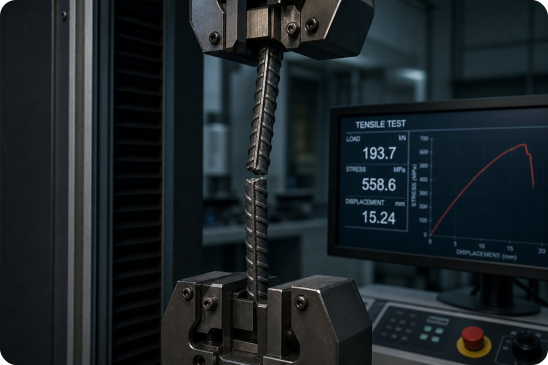
We engineer our couplers to satisfy the 'Bar-Break' criteria. Under extreme static tensile failure tests, structural rupture occurs exclusively in the parent reinforcing bar outside the splice assembly. This proves that the mechanical splice joint is physically stronger than the high-strength steel it connects.
To prevent microscopic movement that can cause internal concrete micro-cracking under daily operational loads, the standard dictates a strict residual slip threshold after pre-loading.
While the Indian Standard permits a permanent structural slip of up to 0.1 mm, Konnexa’s internal quality controls reject any components displaying a slip deviation above 0.05 mm, ensuring absolute load-path rigidity.
IS Standard Limit
0.1
IS Standard Limit
Konnexa Limit
<0.05
mm maximum
Given the high seismic vulnerability of major Indian infrastructure zones, couplers must survive dynamic reverse-stress fluctuations without losing structural integrity.
Our couplers successfully undergo dynamic testing involving 100 continuous cycles of alternating tensile stress variations ranging from 5% to 90% of the characteristic yield strength (fy = 550 N/mm²). The product retains 100% of its structural capacity post-test with zero evidence of stress fracturing.
100
Continuous Cycles
5%-90%
Stress Variation of fy
100%
Capacity Retained
Global Alignment

Seamless compliance with the Plain and Reinforced Concrete Code of Practice, permitting full structural utilization of mechanical splices in heavy structures.

Quality Management System integration covering raw material supply chains, CNC precision tolerance tracking, and field validation systems.

Fully aligned with international structural safety codes including ACI 318 (American Concrete Institute), Eurocode 2 (EN 1992), and BS 8110 (British Standards) for multi-national asset development.

Engineering precision, structural performance, and manufacturability. Our rebar coupler systems use advanced CAD/CAM design, precision CNC machining, and rigorous validation for optimum load transfer and durability.

Strictly engineered to meet IS 16172 & IS 13920 (Indian Standards), ACI 318 & ASTM A1034 (American Standards), and EN 1992-1-1 Eurocode 2. Guaranteed compliance for high-ductility seismic detailing.

Engineering excellence with customer-focused solutions. From individual home builders to large infrastructure projects, our products deliver superior strength, precision, and ease of installation with dedicated technical support.

Sales & After-Sales Support with seamless execution from consultation to handover. Expert advice, on-site technical training, machinery support, and 24-hour on-site assistance for complete peace of mind.

Advanced CNC machinery, premium-grade raw materials, and stringent quality control. Automated high-precision roll-threading and forging with micro-level tolerance accuracy across Thread X, Forge X, and Tapper X product lines.

Complete transparency with unique batch traceability. Mill Test Certificates for raw material verification, NABL-accredited laboratory testing, and independent validation ensuring bar-break performance and compliance.